
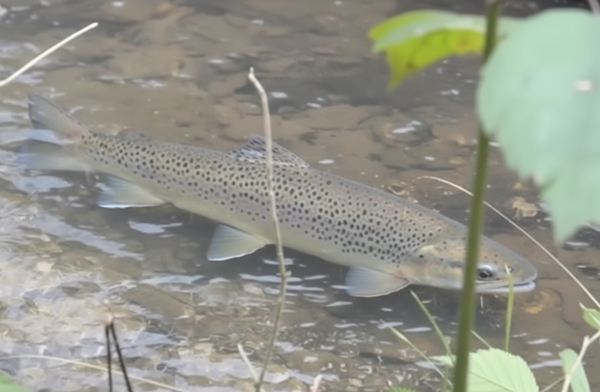
Time is running out to save a variety of fish known as the Sussex tiger, according to naturalist and author Dave Bangs.
Mr Bangs said that the native trout, found in the area since at least the ice age, is at risk as more housing is built close to its natural breeding spots.
He said: “The Sussex tiger is a unique variety of sea trout. It is larger than any other variety in England and Wales, has a different spawning season and is behaviourally distinct.
“Current major housing development proposals close to or fronting local streams, which are crucial for the life cycle of the Sussex tiger, together with disastrous declines in the water system caused by rising regional hyper-development pressures, service collapse and climate change mean these giant fish face extinction.
“They migrate from the sea to breed in the catchments of the River Ouse and Adur, and sometimes in adjacent rivers, in the central Sussex Low Wealden Vale.
“They depend upon a small number of streams which possess gravels and other natural water features in which the sea trout can make their nests and lays their eggs and the juveniles can grow.
“Between 750 and 1,100 new homes are proposed at Cooksbridge, north of Lewes, fronting the North End Stream and its subsidiary streams.
“At the same time there is the threat of new housing and a revived major housing proposal near Plumpton, next to the Bevern Stream, which has already lost water quality and seen declining sea trout populations.
“These plans for major housing developments are an existential threat to the Sussex tiger.”
Despite its name, the Sussex tiger has spots rather than stripes as well as sharp hunter’s teeth. It can grow to 2ft 6in (75cm) or longer and reach a weight of 15lb – or about 7kg – or more.
Mr Bangs said: “After its birth and youth in Wealden streams, these trout change their form and migrate down-river to the salty estuary and the sea where they may live and feed for many months or several years on the rich marine food available inshore or further offshore near the continental Channel coasts.”
After growing large, he said, they migrate back from the sea to breed in their natal Sussex streams, adding: “Many sea trout return and return again in season after season.”
Mr Bangs said that the Wealden Vale was already deep in a water crisis. There had been a drought order recently in place in Kent.
But more widely, there were flood warnings, run-off, pollutants, sewage overflows, drying out spawning head streams, low flows and water warming.
He said: “Present water infrastructure is unable to cope with existing levels of human need, let alone much higher levels of need. It is in a constant state of breakdown.
“Unequal regional hyper-development’s increased water extraction has already shrunk the aquifer and caused head streams that always hosted spawning sea trout to dry and wither downstream.
“These combined pressures look set to bring the Sussex tiger to the point of extinction. That will constitute an ecocide and a ‘rivercide’.”
Mr Bangs said: “Housing proposals which deplete and damage water resources in the catchments which are home to the Sussex tiger – and bring new forms of disturbance and encroachment – should not go ahead.
“This is particularly true of the Cooksbridge proposals which threaten the North End Stream, a core spawning stream.
“These housing proposals are contained within Lewes District Council’s ‘Local Plan Spatial Strategy for Development in Our Plan Area’.
“They are currently the subject of the ‘phase 2 consultation’ which ends on Saturday 28 February.
“Comments on Strategic Policy CB1: Land to the north of Cooksbridge (Site ref 11HY) and Strategic Policy CB2: Land to the east of Cooksbridge (Site ref 19HY) must be submitted by Saturday 28 February 2026 to Lewes District Council.
“A planning application for the first phase of this proposed development is currently lodged with Lewes District Council. It is titled LW/25/0339 on the (council’s) planning portal.
“Objections and comments must be submitted by Friday 20 February 2026.